Free IPTV Playlists: Security and Rights Checks
20 octobre 2026 · 8 min · The IPTV Team
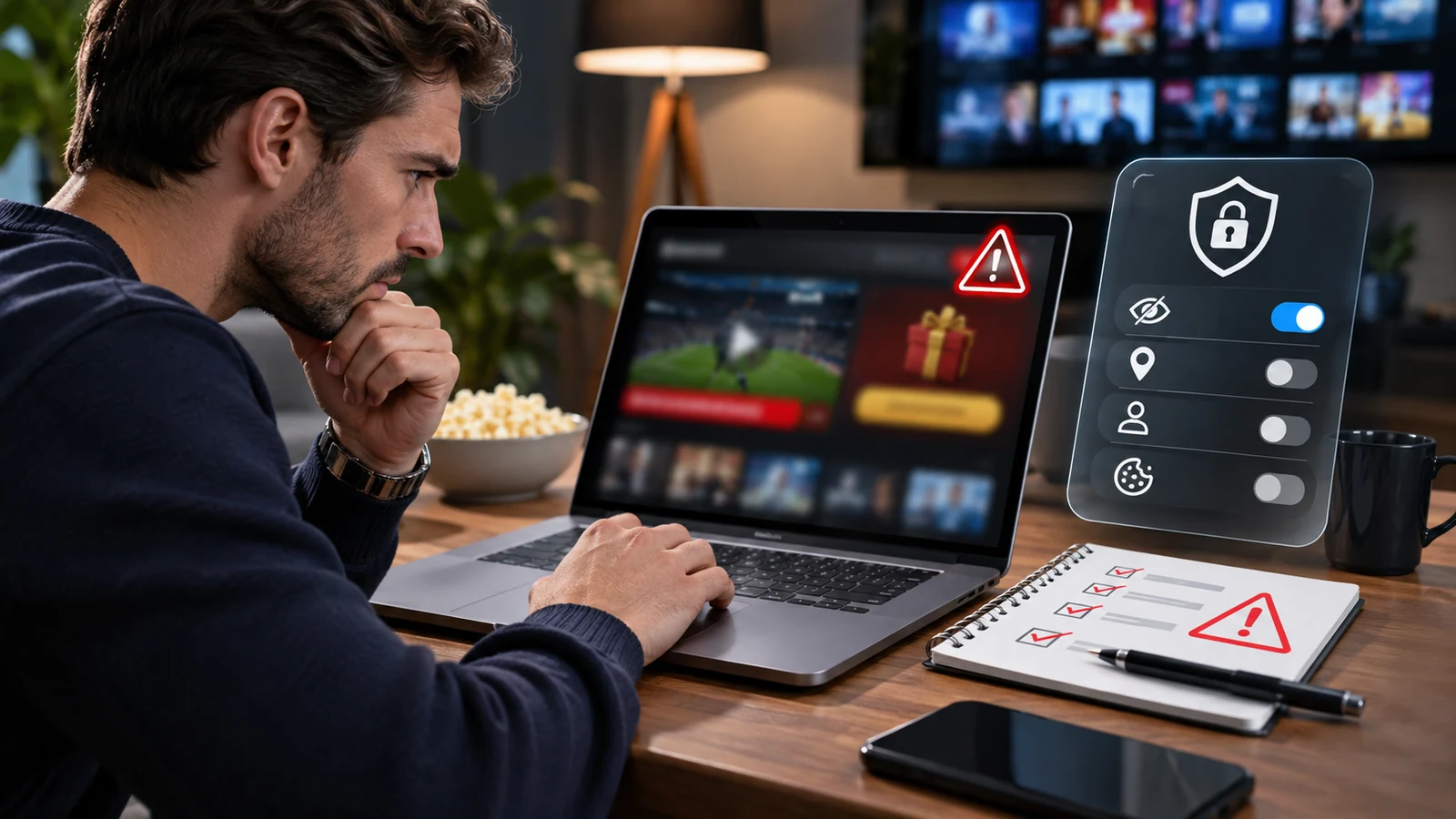
“Free” does not tell you who operates a playlist, what data an app collects or whether a stream is authorized. Treat an unfamiliar link or download with the same care as any other software or online service: verify the publisher, review permissions and avoid sharing personal information.
Understand what an M3U playlist does
An M3U file or URL is a list of media locations that a compatible player can read. The format does not certify the source, guarantee that streams will work or grant rights to view the content. Keep playlist URLs private because they may contain account credentials. See the M3U format overview for general technical background.
Check the app and source
- Verify the publisher: use an official store or a download page linked by the developer.
- Review permissions: be cautious when an app requests access unrelated to playback.
- Protect credentials: do not paste playlist URLs into public forums or unknown converters.
- Check content rights: ask who supplies the streams and whether the service is authorized for your territory.
Unverified downloads and links can expose devices to malware, phishing or unwanted data collection. That risk is not unique to IPTV; it is a reason to use trusted sources and keep software updated. A payment or a polished website also does not by itself prove that a service has the rights to distribute content.
Compare services carefully
Before paying for any service, check the business identity, written terms, actual plan price, renewal and cancellation process, supported devices and refund policy. Be wary of unusually broad promises about channel totals, permanent availability or picture quality. Read our guide to legality and content rights for more context.
Make an informed choice
A free playlist may be unreliable, unauthorized or simply unsuitable for your device; evaluate the source rather than assuming any one outcome. If you choose a paid service, review its current terms and rights information before sharing payment or account details. Current plan information for this site is on the pricing page.
Understand the risks of free offers
“Free” may mean a trial, an ad-supported channel, a public-domain library or a stream distributed without authorization. Those situations have different implications. Identify the publisher, funding model and terms before clicking. France’s media regulator ARCOM explains how to recognize a lawful cultural offer in its guidance on legal offers and piracy.
Unknown sites may display deceptive pop-ups, ask you to install unverified software or collect payment details under the promise of free access. A browser padlock encrypts the connection but does not prove a seller owns the rights. Do not enter payment details until you verify the company, contact details, renewal and cancellation rules. When the source of a stream is unclear, choose an official service or one that explicitly documents its authorization.
Build a choice around your household
A useful decision is more than a channel list or a promise of picture quality. Describe a typical week: who watches the news, whether children use the television, which events must be watched live and how many screens are active in the evening. This snapshot helps avoid paying for features nobody uses and reveals which needs household members share. Separate regular habits from occasional interests, such as a major tournament or a new series. You can then compare services over a period that reflects real use. Set a few measurable criteria. List priority programmes, the main device, subtitle languages, accessibility options, simultaneous streams and an annual budget ceiling. Distinguish the player app, internet connection and company supplying the content. This matters when deciding whom to contact, who processes account details and who must hold distribution rights. If an offer does not make these roles clear, wait for a direct answer before committing.
Verify details before subscribing
Offer pages change faster than general guides. When comparing, open the provider’s official page, check the terms’ date or version and save a record of what was offered. Note the regular price after a discount, billing frequency, renewal date, trial period and cancellation steps. Find out whether hardware is rented, purchased or billed separately and whether setup fees are refundable. If several services are needed for one programme, calculate their combined cost rather than comparing each subscription in isolation. A simple grid makes the comparison verifiable. Use one row per service and columns for twelve-month cost, programmes, number of screens, supported devices, support, rights and exit terms. Add the date you checked because an offer can change later. If prices are shown in another currency, convert them at purchase time and check possible bank fees. Do not rely on an old advert or screenshot. The seller’s contract terms take precedence over summaries, and a reputable service should answer questions about billing and content.
Run a sensible trial and protect your data
If the provider offers a trial or demo, use it to check what matters: connection in the intended room, remote navigation, subtitle availability, stability at busy times and operation on each planned device. Try an ordinary viewing period, not only a short clip. Record errors and ask support if they persist. A demo cannot guarantee identical quality in every condition, but it can reveal obvious incompatibilities before a longer commitment. Protect account information as well. Choose a unique password, enable available security features and do not post credentials or playlist links publicly. Before adding a payment method, understand the first billing date and cancellation process. Remove devices you no longer own and review privacy terms. These steps reduce unexpected charges and access by others, while making support easier if you need to report a problem.
Build a choice around your household
A useful decision is more than a channel list or a promise of picture quality. Describe a typical week: who watches the news, whether children use the television, which events must be watched live and how many screens are active in the evening. This snapshot helps avoid paying for features nobody uses and reveals which needs household members share. Separate regular habits from occasional interests, such as a major tournament or a new series. You can then compare services over a period that reflects real use. Set a few measurable criteria. List priority programmes, the main device, subtitle languages, accessibility options, simultaneous streams and an annual budget ceiling. Distinguish the player app, internet connection and company supplying the content. This matters when deciding whom to contact, who processes account details and who must hold distribution rights. If an offer does not make these roles clear, wait for a direct answer before committing.
Verify details before subscribing
Offer pages change faster than general guides. When comparing, open the provider’s official page, check the terms’ date or version and save a record of what was offered. Note the regular price after a discount, billing frequency, renewal date, trial period and cancellation steps. Find out whether hardware is rented, purchased or billed separately and whether setup fees are refundable. If several services are needed for one programme, calculate their combined cost rather than comparing each subscription in isolation. A simple grid makes the comparison verifiable. Use one row per service and columns for twelve-month cost, programmes, number of screens, supported devices, support, rights and exit terms. Add the date you checked because an offer can change later. If prices are shown in another currency, convert them at purchase time and check possible bank fees. Do not rely on an old advert or screenshot. The seller’s contract terms take precedence over summaries, and a reputable service should answer questions about billing and content.
Run a sensible trial and protect your data
If the provider offers a trial or demo, use it to check what matters: connection in the intended room, remote navigation, subtitle availability, stability at busy times and operation on each planned device. Try an ordinary viewing period, not only a short clip. Record errors and ask support if they persist. A demo cannot guarantee identical quality in every condition, but it can reveal obvious incompatibilities before a longer commitment. Protect account information as well. Choose a unique password, enable available security features and do not post credentials or playlist links publicly. Before adding a payment method, understand the first billing date and cancellation process. Remove devices you no longer own and review privacy terms. These steps reduce unexpected charges and access by others, while making support easier if you need to report a problem.
Build a choice around your household
A useful decision is more than a channel list or a promise of picture quality. Describe a typical week: who watches the news, whether children use the television, which events must be watched live and how many screens are active in the evening. This snapshot helps avoid paying for features nobody uses and reveals which needs household members share. Separate regular habits from occasional interests, such as a major tournament or a new series. You can then compare services over a period that reflects real use. Set a few measurable criteria. List priority programmes, the main device, subtitle languages, accessibility options, simultaneous streams and an annual budget ceiling. Distinguish the player app, internet connection and company supplying the content. This matters when deciding whom to contact, who processes account details and who must hold distribution rights. If an offer does not make these roles clear, wait for a direct answer before committing.
Verify details before subscribing
Offer pages change faster than general guides. When comparing, open the provider’s official page, check the terms’ date or version and save a record of what was offered. Note the regular price after a discount, billing frequency, renewal date, trial period and cancellation steps. Find out whether hardware is rented, purchased or billed separately and whether setup fees are refundable. If several services are needed for one programme, calculate their combined cost rather than comparing each subscription in isolation. A simple grid makes the comparison verifiable. Use one row per service and columns for twelve-month cost, programmes, number of screens, supported devices, support, rights and exit terms. Add the date you checked because an offer can change later. If prices are shown in another currency, convert them at purchase time and check possible bank fees. Do not rely on an old advert or screenshot. The seller’s contract terms take precedence over summaries, and a reputable service should answer questions about billing and content.
Run a sensible trial and protect your data
If the provider offers a trial or demo, use it to check what matters: connection in the intended room, remote navigation, subtitle availability, stability at busy times and operation on each planned device. Try an ordinary viewing period, not only a short clip. Record errors and ask support if they persist. A demo cannot guarantee identical quality in every condition, but it can reveal obvious incompatibilities before a longer commitment. Protect account information as well. Choose a unique password, enable available security features and do not post credentials or playlist links publicly. Before adding a payment method, understand the first billing date and cancellation process. Remove devices you no longer own and review privacy terms. These steps reduce unexpected charges and access by others, while making support easier if you need to report a problem.
Build a choice around your household
A useful decision is more than a channel list or a promise of picture quality. Describe a typical week: who watches the news, whether children use the television, which events must be watched live and how many screens are active in the evening. This snapshot helps avoid paying for features nobody uses and reveals which needs household members share. Separate regular habits from occasional interests, such as a major tournament or a new series. You can then compare services over a period that reflects real use. Set a few measurable criteria. List priority programmes, the main device, subtitle languages, accessibility options, simultaneous streams and an annual budget ceiling. Distinguish the player app, internet connection and company supplying the content. This matters when deciding whom to contact, who processes account details and who must hold distribution rights. If an offer does not make these roles clear, wait for a direct answer before committing.
Verify details before subscribing
Offer pages change faster than general guides. When comparing, open the provider’s official page, check the terms’ date or version and save a record of what was offered. Note the regular price after a discount, billing frequency, renewal date, trial period and cancellation steps. Find out whether hardware is rented, purchased or billed separately and whether setup fees are refundable. If several services are needed for one programme, calculate their combined cost rather than comparing each subscription in isolation. A simple grid makes the comparison verifiable. Use one row per service and columns for twelve-month cost, programmes, number of screens, supported devices, support, rights and exit terms. Add the date you checked because an offer can change later. If prices are shown in another currency, convert them at purchase time and check possible bank fees. Do not rely on an old advert or screenshot. The seller’s contract terms take precedence over summaries, and a reputable service should answer questions about billing and content.
Run a sensible trial and protect your data
If the provider offers a trial or demo, use it to check what matters: connection in the intended room, remote navigation, subtitle availability, stability at busy times and operation on each planned device. Try an ordinary viewing period, not only a short clip. Record errors and ask support if they persist. A demo cannot guarantee identical quality in every condition, but it can reveal obvious incompatibilities before a longer commitment. Protect account information as well. Choose a unique password, enable available security features and do not post credentials or playlist links publicly. Before adding a payment method, understand the first billing date and cancellation process. Remove devices you no longer own and review privacy terms. These steps reduce unexpected charges and access by others, while making support easier if you need to report a problem.
Build a choice around your household
A useful decision is more than a channel list or a promise of picture quality. Describe a typical week: who watches the news, whether children use the television, which events must be watched live and how many screens are active in the evening. This snapshot helps avoid paying for features nobody uses and reveals which needs household members share. Separate regular habits from occasional interests, such as a major tournament or a new series. You can then compare services over a period that reflects real use. Set a few measurable criteria. List priority programmes, the main device, subtitle languages, accessibility options, simultaneous streams and an annual budget ceiling. Distinguish the player app, internet connection and company supplying the content. This matters when deciding whom to contact, who processes account details and who must hold distribution rights. If an offer does not make these roles clear, wait for a direct answer before committing.
Verify details before subscribing
Offer pages change faster than general guides. When comparing, open the provider’s official page, check the terms’ date or version and save a record of what was offered. Note the regular price after a discount, billing frequency, renewal date, trial period and cancellation steps. Find out whether hardware is rented, purchased or billed separately and whether setup fees are refundable. If several services are needed for one programme, calculate their combined cost rather than comparing each subscription in isolation. A simple grid makes the comparison verifiable. Use one row per service and columns for twelve-month cost, programmes, number of screens, supported devices, support, rights and exit terms. Add the date you checked because an offer can change later. If prices are shown in another currency, convert them at purchase time and check possible bank fees. Do not rely on an old advert or screenshot. The seller’s contract terms take precedence over summaries, and a reputable service should answer questions about billing and content.
Run a sensible trial and protect your data
If the provider offers a trial or demo, use it to check what matters: connection in the intended room, remote navigation, subtitle availability, stability at busy times and operation on each planned device. Try an ordinary viewing period, not only a short clip. Record errors and ask support if they persist. A demo cannot guarantee identical quality in every condition, but it can reveal obvious incompatibilities before a longer commitment. Protect account information as well. Choose a unique password, enable available security features and do not post credentials or playlist links publicly. Before adding a payment method, understand the first billing date and cancellation process. Remove devices you no longer own and review privacy terms. These steps reduce unexpected charges and access by others, while making support easier if you need to report a problem.
Ready to enjoy IPTV?